Skip to main content
Monday–Friday · 9:00 AM – 5:00 PM ET·independent · Insuring businesses nationwide

Licensed Business Insurance Agent
7 min read
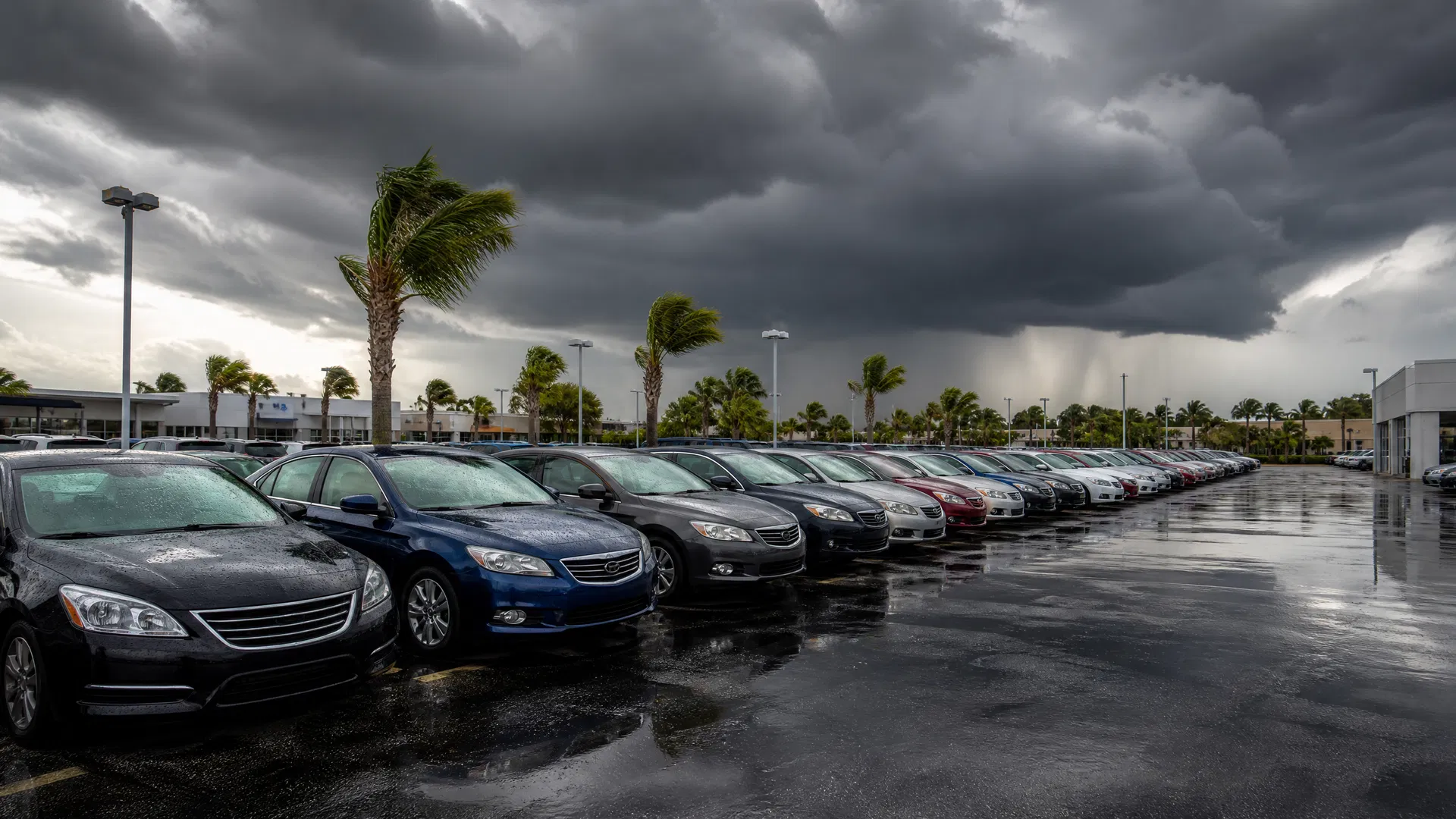
Hail, wind, or flood can damage a sale-ready lot in hours—leaving a dealership with reconditioning costs, impaired inventory value, and floor-plan obligations that do not pause after a storm. The practical answer is to confirm that the Dealer Open Lot (DOL) or other auto physical-damage policy specifically covers the weather perils, vehicles, locations, limits, and deductible structure that apply to your business. The DOL label alone does not establish that hail, wind, or flood is covered; the declarations and endorsements do.
Why weather damage is a business problem
Open-lot vehicles are exposed to several kinds of loss:
- Hail can dent panels, crack glass, and reduce a vehicle's retail value.
- Wind can move or overturn vehicles and send debris into inventory.
- Flood can damage interiors, engines, and electronics, potentially taking vehicles out of saleable condition.
One storm can affect many units at once. That can tie up cash needed for repairs, replacement inventory, and floor-plan payments while the dealership works to restore sales operations.
What to confirm before the next storm
DOL is a type of auto physical-damage coverage designed for dealer inventory. Its coverage is not standardized: insurer, state, endorsement, scheduled location, and policy form all matter. One current dealer program, for example, offers flood options for many dealership exposures and aggregate wind/hail deductibles whose terms vary by state. That is useful evidence that these features must be compared, not assumed. [3]
Hail and wind
Ask whether hail and wind are covered causes of loss for the inventory at every scheduled lot and approved temporary storage location. Then identify any wind/hail or named-storm endorsement. A catastrophe deductible can apply per vehicle, per occurrence, per location, or across a storm; it may be a dollar amount or a percentage of a limit or reported values. Ask for the deductible's dollar impact at peak inventory value, rather than relying on a rule of thumb.
Flood is a separate question
Ask whether the DOL or auto physical-damage form itself covers flood for dealer-owned, floored, and consigned vehicles at each listed location. Do not assume a commercial property flood policy solves an open-lot vehicle exposure.
For example, an NFIP commercial policy can insure commercial buildings and certain business property, but FEMA's General Property Form excludes personal property that is not inside a fully enclosed building and self-propelled vehicles licensed for public-road use. FEMA's commercial coverage guidance likewise lists most cars and property outside the insured building among items not covered. [1] [2] A commercial flood policy may therefore be valuable for the building or eligible inside contents without insuring the cars on the lot. Private flood and DOL terms can differ, so compare the actual flood wording, location schedule, limit, and deductible before relying on either policy.
A practical coverage checklist
Review the declarations and endorsements with these questions in mind:
- Which vehicles and locations are insured? Confirm ownership interests, floored and consigned inventory if applicable, every regular lot, and any temporary storage arrangement.
- Does the limit match a peak day? Compare the policy limit with the highest total inventory value you could have before a storm, not only an average month.
- How will a loss be valued? Actual cash value, stated amount, and agreed value are different valuation approaches. The policy's approach affects the amount available to repair or replace damaged stock.
- What does the deductible cost in a catastrophe? Obtain the calculation and dollar result at peak inventory, including whether it applies to each unit or to the event as a whole.
- Are reporting and protective conditions present? Some DOL forms require values reporting while others do not. Read the reporting clause, maximum limit, valuation basis, and the result of a late or inaccurate report. Follow any written location, protective-safeguard, and claim-notice conditions in the bound policy.
Reduce loss without guessing at coverage
A storm plan cannot create coverage, but it can reduce disruption. Keep a current inventory list with VINs, locations, and values; document vehicle condition when practical; identify safe, approved relocation options; and review how employees will secure keys and notify management. Moving inventory before severe weather can reduce damage when it is safe and feasible, but whether it is required for coverage depends on the policy's actual written terms.
After a loss, protect people first, take reasonable steps to prevent further damage where safe, preserve records and photos, and report the claim using the instructions in the policy. Do not delay reporting while trying to decide whether a peril is covered.
Related coverage
Explore Commercial Coverages
Compare competitive pricing and meaningful protection for the way your business works, with Ellie on your side.
Keep the floor-plan agreement in the review
A floor plan is financing secured by inventory. The lending agreement may set insurance requirements, limits, deductibles, loss-payee wording, notice obligations, and rules for where collateral may be stored. FDIC floor-plan examination guidance identifies insurance requirements as a typical agreement provision and hazard insurance with the bank as loss payee as documentation lenders may require. Your current agreement—not a generic assumption—controls what your lender expects. 4
Compare the agreement with the current DOL declarations and endorsements. This helps avoid finding after a storm that a deductible, location restriction, or missing endorsement leaves the dealership with an unexpected expense or a collateral issue.
When to revisit the policy
Review dealer inventory coverage when you add or move a lot, use temporary storage, increase peak vehicle values, change the mix of inventory, renew a floor-plan agreement, or approach annual renewal. A review is also worthwhile after a weather loss, because it can show whether the limit, deductible, valuation, or location schedule still fits the way the dealership earns revenue.
How Ellie helps dealerships address weather exposure
Ellie Insurance Group helps auto dealers compare the protection that matters after a storm: covered weather perils, scheduled locations and storage, peak inventory limits, valuation, and the catastrophe deductible in dollars—not just the premium or a bare lender minimum. Ellie can use access to industry-focused insurance programs and compare terms across multiple markets to pursue highly competitive pricing alongside practical protection for the inventory that drives your sales operation.
For a comparison tailored to your dealership, start an Instant Quote. Existing Ellie customers who need help after a storm or want to review current policy documents can call 813-582-5215 or email quote@ellieinsurancegroup.com; a quote is not required to ask for help with an existing policy.
Related Commercial Insurance Pages
FAQs
Is hail damage covered by Dealer Open Lot insurance?
It may be, but do not rely on the DOL name alone. Confirm hail as a covered cause of loss, the covered locations and vehicles, the limit, and any hail or catastrophe deductible in the bound policy.
How does wind coverage work for auto dealer inventory during a hurricane?
Wind coverage and named-storm deductibles are form-specific. Verify the policy's wind wording, the event that triggers any special deductible, and whether the deductible is per vehicle, per occurrence, per location, or aggregate. A dealer program may offer aggregate wind/hail deductibles, but the available terms can vary by state. 3
Does Dealer Open Lot insurance include flood coverage?
Flood is covered only if the DOL or auto physical-damage form grants it for the affected inventory and location. An NFIP commercial flood policy generally is not a substitute for coverage on road-licensed cars kept outside; FEMA's General Property Form excludes both personal property outside a fully enclosed building and self-propelled vehicles licensed for public roads. 1 2
What are floor-plan lender requirements regarding weather coverage?
Your agreement may require physical-damage coverage, a loss-payee clause, specific limits or deductibles, and notice to the lender. Compare the current agreement against your declarations and endorsements. Do not assume that a lender requires—or that a policy provides—any particular weather peril until the documents say so. 4
How can Ellie Insurance Group help with hail, wind, and flood coverage for my dealership?
Ellie helps you compare the weather protection, location schedule, limits, valuation, exclusions, and catastrophe deductible that affect your inventory after a loss. Ellie pairs access to industry-focused programs and multiple-market comparison with highly competitive pricing. Start with an Instant Quote, or, if you are already an Ellie customer and need policy or claim support, call 813-582-5215.
Sources and policy reminder
Coverage is controlled by the policy, declarations, and endorsements issued for your dealership. The sources below explain NFIP commercial limits, a dealer-program example, and floor-plan practices; they do not set the terms of a particular DOL, private flood, or lender agreement.
Put Ellie on your side
Ellie gives your business access to industry-focused programs and highly competitive pricing. We help you compare what you pay with the protection you are buying, and stay in your corner after you buy. Explore the related coverage options or let us help with your business.
About the author
Licensed Business Insurance Agent · Ellie Insurance Group
Licensed business insurance agent at Ellie Insurance Group · Access to 100+ carrier markets.
More about KevinKeep reading
Related Articles
Compliance & renewals
Auto Repair Shop Insurance Checklist
If customer cars are in your bays, a basic liability policy alone may leave important gaps. This auto repair shop insurance checklist helps you separate protection for injuries and third-party damage from protection for…
State requirements
Florida Garage Liability Insurance for Used Car Dealers: 2026 Guide
Florida used-car dealers need protection that does more than satisfy a license filing. A serious test-drive injury, damage to a customer's vehicle, or a loss across the inventory can create an expense that the filing…
Industry guides
Dealer Open Lot Insurance: Protect Your Dealership Inventory From Costly Gaps
A hailstorm, theft, fire, or collision can take sale-ready vehicles off your lot and tie up the cash your dealership needs to replace inventory. Dealer Open Lot insurance (DOL) is first-party physical-damage coverage…
Next step
Competitive pricing. An insurance team in your corner.
Take advantage of Ellie's industry-focused programs and competitive market access. Let us help you find coverage for the way you work, compare the real protection behind the price, and support your business after you buy.