Skip to main content
Monday–Friday · 9:00 AM – 5:00 PM ET·independent · Insuring businesses nationwide


Licensed Business Insurance Agent
7 min read
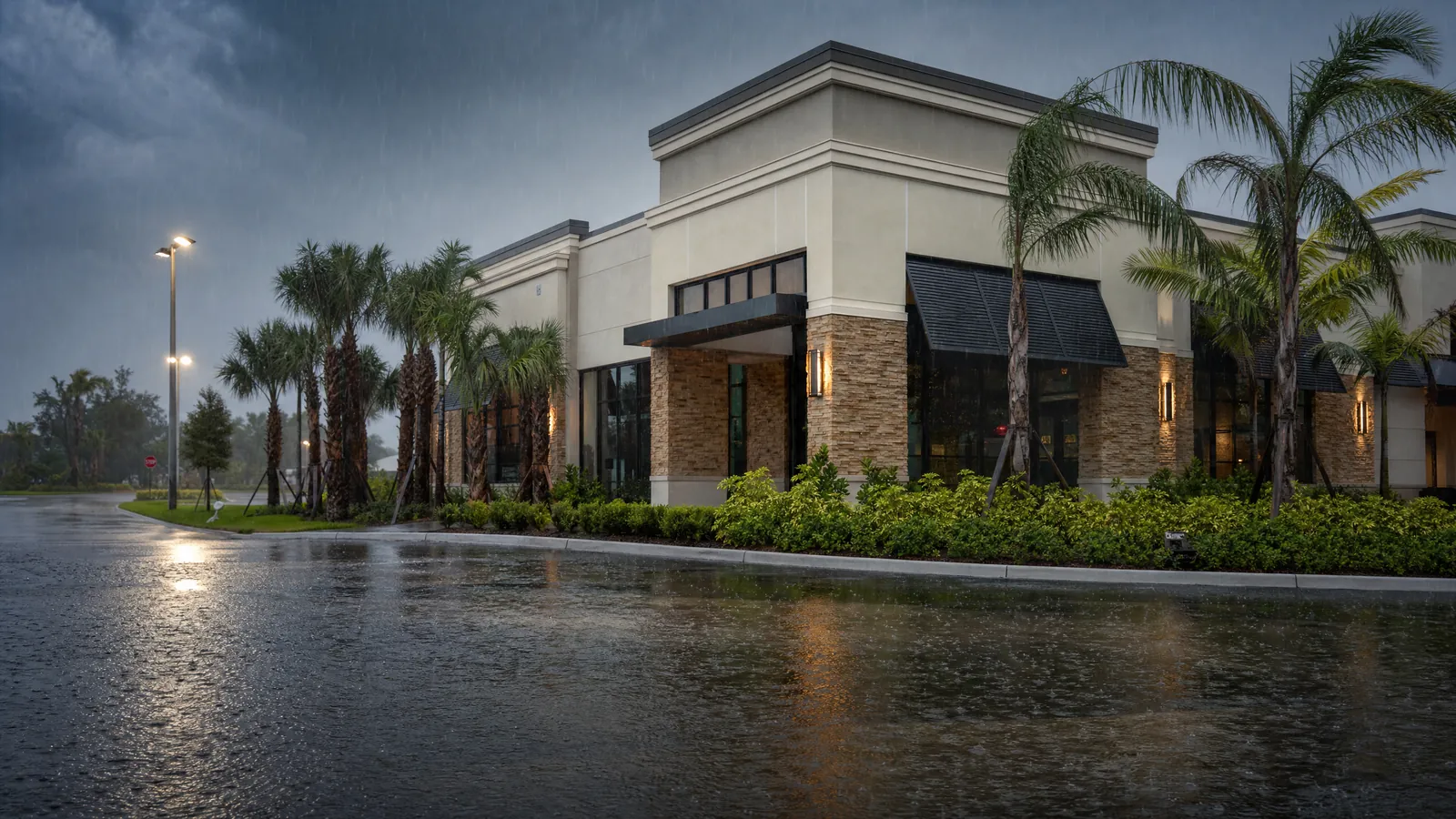
Commercial flood insurance in Florida is the coverage to examine when storm surge, overflowing water, heavy runoff, or mudflow could damage the building, stock, equipment or furnishings that keep your business operating. Most standard business-property policies do not insure a policy-defined flood. Start by identifying whether you need coverage for the building, its contents, or both—and whether a shutdown would threaten payroll, rent or customer commitments. National Flood Insurance Program (NFIP) commercial coverage offers separate building and contents limits of up to $500,000 each, but it does not cover lost business income. A private policy may offer different limits or income coverage, so compare the actual policy before relying on it. [1] [2]
Start With What Could Interrupt Your Business
Flood coverage is not only a question for a waterfront business. A storm-surge loss can damage a coastal location, while surface-water runoff can spoil stock, disable machinery, or close an office or warehouse. The important distinction is the insurance policy's definition of flood, not simply whether water came from outdoors.
For NFIP coverage, a flood is a general and temporary inundation of normally dry land that generally affects two or more acres or two properties, with at least one being the insured property. It can result from overflow of inland or tidal waters, unusual and rapid surface-water accumulation or runoff, or mudflow. A burst pipe or rain through a damaged roof is not NFIP flood; whether a commercial-property policy responds to either loss depends on its cause-of-loss form, exclusions, and the facts of the loss. [2]
Owner, Tenant, or Both?
An owner usually needs to evaluate the building and the business contents separately. A tenant may need contents coverage for stock, furniture, machinery, equipment, and other property inside the space, while the lease may make the tenant responsible for certain improvements. Under the NFIP General Property Form, up to 10% of contents coverage can apply to improvements a tenant made to an occupied building. Review the lease alongside the policy: a landlord's building policy does not automatically protect the tenant's property or keep the tenant's business operating. [1]
Before choosing limits, list what a flood could cost to repair or replace: the building interest you are responsible for, inventory at its seasonal high point, equipment and machinery, and tenant improvements. Then decide how much financial disruption your business could absorb while repairs are underway. This turns a generic flood question into a protection decision tied to the way your business earns income.
NFIP and Private Flood Options
The NFIP is FEMA's federal flood-insurance program. Under its General Property Form, building coverage and contents coverage are separate choices, each available up to $500,000 for eligible commercial property. They also have separate deductibles. Covered contents can include stock, furniture, machinery, and equipment inside the insured building. [1]
NFIP commercial claims are generally settled on an actual-cash-value basis: replacement cost less depreciation, subject to the limit and policy terms. That is different from assuming that the policy will pay today's full replacement cost. NFIP commercial coverage also excludes business interruption or loss of use, most autos, and property outside the insured building. Sewer backup is not covered unless area flooding caused the backup. [1] [2]
Private flood insurance can be an alternative or a supplement, and its terms may differ from the NFIP form. Some private policies may include business-income coverage. Business income is the coverage designed to address lost income and continuing expenses after a covered interruption; it is especially relevant when a closure could cost contracts, payroll capacity, or regular customers. Its trigger, limit, deductible, waiting period, and length of payment are policy-specific. [3]
Compare the Actual Protection, Not Just the Premium
When comparing NFIP and private options, ask for the declarations and policy form, then check:
- whether the policy's flood definition fits the property's exposure;
- separate building, contents, and tenant-improvement interests, plus the limit and deductible for each;
- how a loss is valued—actual cash value or the valuation stated by the private policy;
- whether business-income coverage is included, and its waiting period, limit, and maximum payment period;
- key exclusions, including outside property, autos, and sewer-backup conditions; and
- whether the lender will accept the proposed policy and limit.
Ellie Insurance Group helps Florida businesses compare NFIP and private flood options around the property, lease, lender request, and the income the business needs to protect. Ellie combines extremely competitive pricing with access to its industry-focused insurance programs, helping you compare the limits, deductibles, valuation, and business-income terms that matter—not merely a minimum requirement. The agency can also help you revisit the decision as property, inventory, or contract obligations change.
Florida Lender, Timing, and Documentation Considerations
A Lender Minimum Is Not a Recommended Limit
Federal law generally requires flood insurance for the term of a designated loan secured by a building or mobile home in a Special Flood Hazard Area (SFHA) where flood insurance is available. The required amount is generally the lesser of the outstanding loan balance or the maximum NFIP coverage available for that property type. Your loan agreement may require more coverage or flood coverage outside an SFHA, so confirm the lender's written requirement. [4]
That lender minimum is a loan condition, not a calculation of what it would cost to rebuild, replace contents, or withstand a loss of income. Compare it against your own building and contents exposure before deciding whether it is enough protection for the business.
Do Not Wait for the Forecast
An NFIP policy generally becomes effective 30 days after purchase. FEMA describes exceptions for certain mortgage transactions and coverage changes at renewal, along with specific map-change and federal-wildfire situations that have a one-day wait. Private insurers may apply their own binding restrictions. Address flood coverage well before a forecast so the policy can be effective when it is needed. [5]
Elevation Certificates
An Elevation Certificate documents a building's elevation. Under current NFIP pricing, it is not required to buy coverage or ordinarily to set the rate, but an owner may submit one through an agent to see whether it could lower the premium. It can also matter for local floodplain-management or building requirements. [6]
Related coverage
Explore Commercial Coverages
Compare competitive pricing and meaningful protection for the way your business works, with Ellie on your side.
When to Review Your Flood Coverage
Review limits and terms when FEMA changes a flood map, you renovate or add space, inventory or machinery increases, the lease changes, or a lender renews or modifies its requirement. An annual review is also a practical time to compare an NFIP policy with available private options and confirm that deductibles and any business-income protection still match the business's ability to absorb a shutdown.
If you are already insured with Ellie and need help reviewing your flood policy, lender request, or a potential flood loss, call 813-582-5215 or email quote@ellieinsurancegroup.com. Follow the policy's claim-reporting instructions promptly after a loss.
Related Commercial Insurance Pages
FAQs
Is commercial flood insurance required in Florida?
It is generally required for the term of a designated loan secured by a building or mobile home in an SFHA where flood insurance is available. The required amount is generally the lesser of the loan balance or the maximum NFIP limit for the property type. A lender can impose a different contractual requirement, including one outside an SFHA, so ask for its written requirement. 4
Does a standard commercial property policy cover flood damage?
Most standard business-property policies do not cover a policy-defined flood. A burst pipe or rain through a damaged roof is not NFIP flood, but coverage under a commercial-property policy depends on its form, exclusions, and the facts of the loss. Read both policies before assuming one will respond. 2
What is the difference between NFIP and private commercial flood insurance?
NFIP commercial coverage has standardized terms with separate building and contents coverage, each available up to $500,000, and commercial losses are generally settled at actual cash value. Private policies can differ in limits, valuation, exclusions, deductibles, waiting or binding restrictions, and business-income coverage. Compare the actual form and confirm lender acceptance before choosing. 1 3
Does commercial flood insurance cover lost business income?
NFIP commercial flood coverage does not cover lost business income. Some private policies may provide it, but the covered trigger, waiting period, limit, deductible, and payment period appear in the policy. Compare those terms to the income and ongoing expenses your business would face during a flood-related closure. 1 3
How long does commercial flood insurance take to take effect?
NFIP coverage generally has a 30-day waiting period, with limited exceptions described by FEMA. Private insurers set their own timing and binding restrictions. Arrange coverage before a storm is forecast rather than assuming a new policy will be effective immediately. 5
Instant Quote
Ready to compare building, contents, and business-income protection for your Florida business? Start an Instant Quote with Ellie Insurance Group. We will help you compare the flood protection and highly competitive pricing that fit the property, operations, and obligations you need to protect.
Sources
Put Ellie on your side
Ellie gives your business access to industry-focused programs and highly competitive pricing. We help you compare what you pay with the protection you are buying, and stay in your corner after you buy. Explore the related coverage options or let us help with your business.
About the author
Licensed Business Insurance Agent · Ellie Insurance Group
Licensed business insurance agent at Ellie Insurance Group · Access to 100+ carrier markets.
More about KevinKeep reading
Related Articles
State requirements
Florida Commercial Property Insurance: Hurricane Prep and Wind Deductibles Explained
A hurricane can leave a Florida business with a damaged building, spoiled inventory, missed sales, and a large deductible due before property coverage pays. The practical answer is to review the policy before a storm…
State requirements
Florida Commercial Property Insurance: Wind, Flood, Roof and Income Coverage
Does your property policy leave your business paying a large share after a hurricane, flood, or roof loss? Start with four answers: Is wind included or excluded? What deductible applies and what event triggers it? Is…
Industry guides
Dealer Inventory Insurance for Hail, Wind and Flood Losses
Hail, wind, or flood can damage a sale-ready lot in hours—leaving a dealership with reconditioning costs, impaired inventory value, and floor-plan obligations that do not pause after a storm. The practical answer is to…
Next step
Competitive pricing. An insurance team in your corner.
Take advantage of Ellie's industry-focused programs and competitive market access. Let us help you find coverage for the way you work, compare the real protection behind the price, and support your business after you buy.