Skip to main content
Monday–Friday · 9:00 AM – 5:00 PM ET·independent · Insuring businesses nationwide

Industry guides
New Mexico Contractor License Bond Requirements
New Mexico CID license bond amounts, GB-98 vs specialty classifications, and the GL/WC requirements that come with a CID license.

Licensed Business Insurance Agent
Last reviewed June 2026 7 min read
Key takeaway
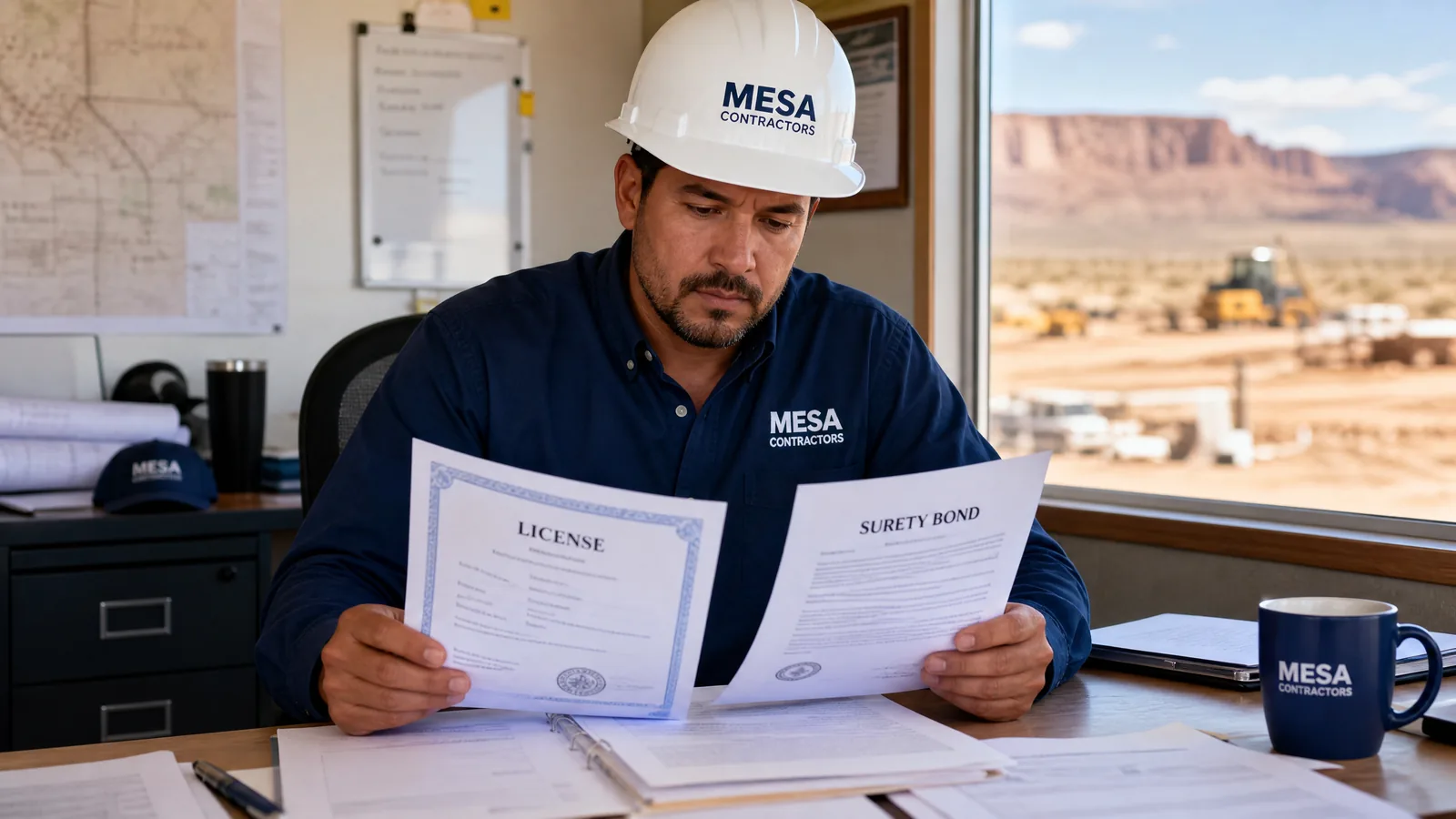
New Mexico's Construction Industries Division (CID) licenses every contractor performing work over $7,200, and a license bond is part of the license — commonly in the $10,000–$20,000 range depending on classification.
Quick Answer: New Mexico's Construction Industries Division (CID) licenses every contractor performing work over $7,200, and a license bond is part of the license — commonly in the $10,000–$20,000 range depending on classification and contract size. On top of the bond, construction contractors must carry workers' compensation once they have employees (construction is treated as a special class), and most general contractors and project owners require $1M/$2M general liability with additional insured status even though the state doesn't mandate GL for the license itself. Always confirm current bond amounts and rules at the CID portal before applying.
A contractor license bond is not insurance for you — it protects the public, and a paid bond claim becomes a debt you owe the surety. Understanding how New Mexico's bonding, licensing, and insurance requirements fit together helps you get licensed correctly and avoid the gaps that cost contractors jobs and money. Ellie Insurance Group helps New Mexico contractors shop on your behalf for New Mexico commercial insurance, comparing 100+ carrier markets for the GL, workers' comp, and bonds that contracts actually require.
What Contractors Need to Know
New Mexico draws a clear line at $7,200: under NMSA 1978 § 60-13-3, any contractor performing work above that amount must be licensed through the Construction Industries Division of the Regulation and Licensing Department. Licenses are issued by classification — GB-98 (general building), GA-98 (general engineering), GF-04 (residential), and dozens of specialty trades — and each classification defines the scope of work you're authorized to perform. To get licensed, applicants generally must pass trade and business/law exams, demonstrate roughly four years of trade experience, and post a license bond.
The license bond is the part that confuses contractors most. It is a three-party agreement: you (the principal), the surety (the bonding company), and the public (the obligee). If you fail to perform — abandon a job, leave subs or suppliers unpaid, or perform defective work — a valid claimant can file a claim against the bond. The surety pays valid claims and then seeks full reimbursement from you under a general indemnity agreement. In other words, the bond protects your customers, not you, and you remain financially responsible for any claim paid.
The third piece is insurance that comes with operating, distinct from the bond. New Mexico requires workers' compensation for employers at the statutory threshold, and construction is treated as a special class where coverage is triggered with even one employee. General liability is not required for the CID license itself, but it's effectively mandatory in practice because general contractors, project owners, and tribal-land projects require it. Ellie Insurance Group is an independent agency, insuring contractors nationwide, and can coordinate the bond and the insurance so they match the work you're bidding.
Bond Amounts, Licensing, and Insurance at a Glance
| Requirement | Typical New Mexico expectation | Notes |
|---|---|---|
| License threshold | Work over $7,200 requires a CID license | NMSA 1978 § 60-13-3 |
| License bond | Commonly $10,000–$20,000 by classification/contract size | Confirm current amount at the CID portal |
| Bond premium | Often ~1–3% of bond amount per year | A $10,000 bond commonly runs ~$100–$300/yr for qualified applicants |
| Workers' compensation | Required for construction contractors with employees | Construction is a special class; even one employee can trigger it |
| General liability | Not state-mandated for the license, but contract-required | Most GCs/owners require $1M/$2M with additional insured |
Bond amounts are set by classification and contract size, and the figures change with CID rule updates — so the numbers above are typical ranges, not guarantees. Residential and light commercial classifications commonly sit near $10,000, while full GB-98/GA-98 licenses can run $10,000 to $20,000 depending on contract value. Because amounts change, verify the current figure for your exact classification at the CID portal before you apply.
Bond premium is a small percentage of the bond amount, driven largely by your personal credit and business financials. A credit-qualified applicant might pay 1–3% annually — roughly $100–$300 for a $10,000 bond — while weaker credit raises the rate. The bond amount is the maximum the surety will pay on claims; the premium is simply your annual cost to keep it in force.
Insurance is where contractors most often have a false sense of security. The bond does nothing for your own liability or your employees' injuries. Workers' compensation responds to employee injuries (and is required once you have employees in construction), and general liability responds to third-party injury and property damage from your work. Skipping GL because the license doesn't require it usually means losing bids, because the GC's contract requires it. Ellie Insurance Group can place the GL, comp, and bond together through New Mexico commercial insurance.
How This Applies in New Mexico
New Mexico has features that out-of-state contractors don't expect. The $7,200 license threshold is low, so even small jobs can require a license, and performing licensable work without a license carries penalties and can make it hard to collect payment. Classifications are also strict — performing work outside your classification's scope can create both licensing and liability problems.
Tribal-land projects are a distinctive New Mexico issue. With numerous sovereign nations within the state, projects on tribal land can require higher insurance limits and special endorsements (including provisions addressing tribal-court jurisdiction). If you bid that work, confirm the exact insurance and endorsement requirements before signing, because standard policy language may not satisfy them. An independent agency that can access many carriers is valuable here, since not every carrier will write to those terms.
When to Review Your Bond and Coverage
Review your bond and insurance whenever you change classification, take on larger contracts, or expand into new project types like public or tribal work — each can change both your required bond amount and your insurance limits. Also review whenever you add employees, because that can trigger or change your workers' compensation obligation under New Mexico's construction rules.
It's also worth a review at every renewal and whenever your credit or financials improve, since bond premium is credit-driven and a stronger profile can lower your rate. Before bidding any job that names specific limits or additional insured requirements, confirm your policies actually support what the contract asks — discovering a gap after award is the expensive way to learn it.
Related Commercial Insurance Pages
| Page | Why it may matter for NM contractors |
|---|---|
| General Liability Insurance | Contract-required GL with additional insured for most jobs. |
| Workers' Compensation Insurance | Required for construction contractors with employees. |
| Contractors Industry Coverage | Program overview for the building trades. |
| Commercial Auto Insurance | Vehicles and equipment transport for jobsites. |
| New Mexico Commercial Insurance | State-specific coverage and bond support. |
FAQs
When do I need a contractor license in New Mexico?
Any contractor performing work over $7,200 must be licensed through the Construction Industries Division under NMSA 1978 § 60-13-3. The threshold is low, so even small jobs frequently require a license.
How much is a New Mexico contractor license bond?
Bond amounts are set by classification and contract size and commonly fall in the $10,000–$20,000 range, but they change with CID rule updates. Confirm the current amount for your classification at the CID portal before applying.
How much does the bond cost per year?
Premium is typically about 1–3% of the bond amount for credit-qualified applicants, so a $10,000 bond often costs roughly $100–$300 annually. Weaker credit increases the rate.
Does a license bond protect me as the contractor?
No. The bond protects the public — your customers, subs, and suppliers. If the surety pays a valid claim, you must reimburse it under the indemnity agreement. The bond is closer to a credit instrument than insurance.
Do I need general liability for the CID license?
Not for the license itself, but in practice yes — most general contractors, project owners, and tribal-land projects require $1M/$2M general liability with additional insured status before you can work.
When does workers' compensation apply to NM contractors?
Construction is a special class in New Mexico, so workers' compensation is generally triggered once a construction contractor has employees. Confirm your specific obligation with the New Mexico Workers' Compensation Administration.
Instant Quote
Get the bond, general liability, and workers' compensation that your New Mexico license and contracts actually require — placed together so nothing falls through a gap. Ellie Insurance Group shops on your behalf across 100+ carrier markets. Start with New Mexico commercial insurance and choose Instant Quote.
Sources
This guide is general information and is not legal, licensing, tax, or insurance advice. Statutes, thresholds, and licensing rules change; always confirm current requirements with the relevant agency and verify coverage details against the actual policy and a licensed agent.
Working with an independent agent
Coverage needs vary by operation, contract, and state. An Ellie Insurance Group agent can review your situation and shop 100++ carrier markets on your behalf — start an Instant Quote or call 813-582-5215.
Get a real quote
Want a quote for the coverage discussed here? Start with general liability, workers' compensation, or commercial auto — or browse all commercial coverages and industries we serve.
Written & reviewed by
Licensed Business Insurance Agent · Ellie Insurance Group
Licensed business insurance agent at Ellie Insurance Group · Access to 100+ carrier markets.
More about KevinIndependent Agency
100+ carrier markets
5.0★ Google Rating
Verified Google reviews
Trusted Choice 5.0
5-star independent agency
InsuredBetter 5.0
29 verified client reviews
Same-Day Certificates
For active clients during business hours
Instant Commercial Quotes
Most submissions, same business day
Keep reading
Related Articles
State requirements
Florida Workers' Compensation Requirements for Contractors
Florida workers' compensation requirements for contractors are designed to protect workers and limit employer liability. While specific rules apply, many contractors may qualify for exemptions, especially those without…
Coverage explainers
Builders Risk Insurance Explained: Who Needs It and What It Covers
Builders risk insurance helps protect a building or project while it is under construction, renovation, or major improvement. It can cover materials, fixtures, and covered property at the jobsite, but the exact…
Industry guides
Contractors Equipment Insurance: What It Covers and Why You Need It
Contractors equipment insurance helps protect the tools, machinery, and mobile equipment your business relies on at jobsites, in transit, and in storage. It is often written as inland marine coverage because contractor…
Next step
Ready to shop commercial coverage?
Start an instant quote or speak with a commercial agent. We'll review available markets and the carrier's requirements before coverage can be bound.