Skip to main content
Monday–Friday · 9:00 AM – 5:00 PM ET·independent · Insuring businesses nationwide

Licensed Business Insurance Agent
7 min read

General liability insurance helps protect your business when someone else claims your operations injured them, damaged their property, or caused certain advertising-related harm. It does not insure your building, inventory, equipment, or income after a shutdown. A Business Owners Policy (BOP) can package general liability with commercial property coverage and, on many forms, business-income coverage. The practical choice is driven by the loss your business could not comfortably absorb—not just by the policy name.
Start with the loss that could disrupt your business
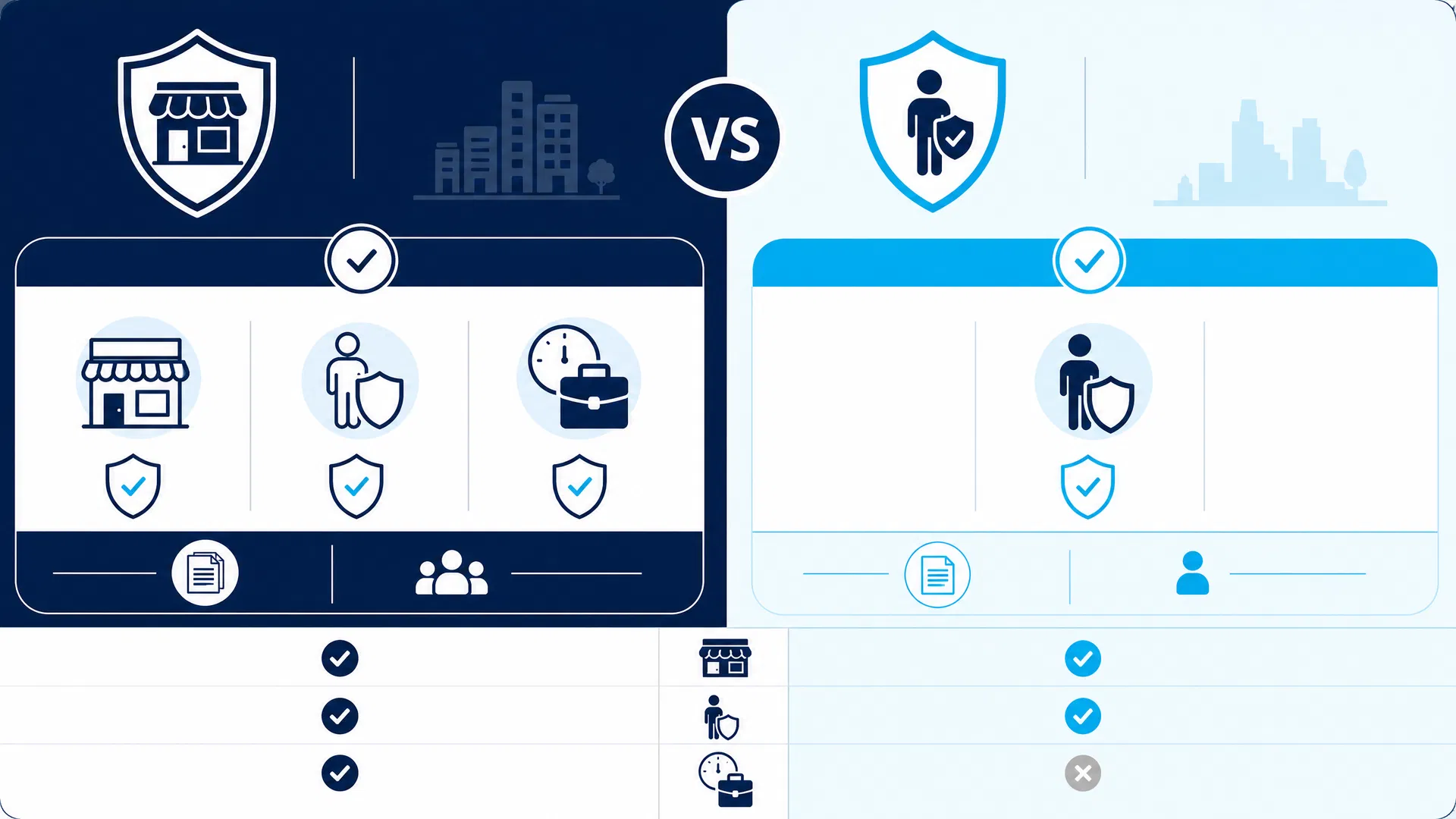
A customer injury claim can threaten cash flow and a contract. A fire can damage the inventory or equipment that produces that cash flow. These are different problems, so general liability and a BOP serve different purposes. General liability (GL) addresses many claims by other people. A BOP adds protection for specified property your business owns or uses and may help with income lost after certain covered property damage.
General liability: claims involving other people
General liability may respond to covered third-party bodily injury, property damage, and personal and advertising injury claims. It can matter when a visitor is hurt at your location, your work accidentally damages someone else's property, or advertising creates a covered allegation such as libel. Payment of damages and defense costs remains subject to the policy's terms, limits, exclusions, and conditions.
- Customer injury: A customer slips in your shop and alleges an injury. GL can help defend and pay a covered claim, protecting the funds your business needs to keep operating.
- Third-party property damage: Your work accidentally damages a client's wall, furniture, or other property. GL may respond, subject to the policy.
- Personal and advertising injury: A covered allegation involving your advertising, such as libel or copyright infringement, may fall within this coverage part.
GL is not a substitute for insuring your own property or replacing your revenue after a covered shutdown. It can also be limited when the property is in your care, custody, or control—for example, a customer's vehicle, equipment, or goods you are repairing or storing. Ask about the specialized coverage that may be needed before assuming ordinary GL will pay for that property. [3]
A BOP: a property-and-liability package
A BOP typically combines general liability with commercial property coverage in one policy. Depending on the form, it may also include business-income coverage. The policy's declarations, coverage form, and endorsements determine what property is covered, which causes of loss apply, and the limits and deductibles that could affect your recovery.
Commercial property coverage can address covered damage to a building you own, tenant improvements, inventory, furniture, computers, and equipment. For example, if a covered fire damages a retailer's stock and point-of-sale equipment, property coverage addresses the physical loss; GL alone would not.
Business income coverage is different from property coverage. It may help replace lost income and pay certain continuing operating expenses when a covered direct physical loss suspends operations. Check the covered causes of loss, any waiting-period or deductible terms, the limit, and the restoration period—the time allowed to repair, rebuild, or replace property. It is not automatic protection for every decline in sales or interruption. [1]
Make the BOP vs. GL decision in five questions
- Could a customer, visitor, or client allege injury or property damage? General liability is usually the starting point for that third-party exposure.
- Would damage to your premises, inventory, equipment, or tenant improvements interrupt your ability to earn income? Commercial property coverage, often available in a BOP, deserves close attention.
- Could a covered property loss stop operations long enough to threaten payroll, rent, or supplier commitments? Review business-income coverage and its restoration-period limit rather than assuming it is included or unlimited.
- Do you hold customer property? Repair shops, warehouses, valet operations, and similar businesses should identify property in their care, custody, or control and ask what specialized coverage applies. [3]
- Do your work or contracts create other exposures? Professional advice or design, data incidents, vehicles, employees, and contractual insurance requirements can call for coverage that GL or a basic BOP does not provide.
A BOP can be an efficient fit when you need both property and liability protection. A standalone GL policy can make sense for a business with little property exposure, but it should not end the conversation. A remote consultant may still have client contract requirements, professional-services exposure, cyber risk, or portable equipment to protect.
Florida property risks: review wind and flood separately
For a Florida location, inspect the property declarations and endorsements to see whether wind is covered, limited, excluded, or subject to a separate deductible. A hurricane can create both wind and flood damage, but they are different perils under insurance policies.
Flood is commonly not covered by standard commercial property coverage. A commercial flood policy can insure direct physical flood damage to a building and its contents, generally with separate limits and deductibles. It does not automatically solve the income lost during a flood-caused shutdown, so review the business-income response separately. [2] [1]
This distinction matters before signing a lease, taking on inventory for a busy season, or relying on a certificate of insurance for a contract. A policy that meets a stated liability limit may still leave a costly property or income gap.
When to revisit the choice
Review your coverage when the way you earn money changes: opening or moving a location, increasing inventory, buying equipment, adding services or products, hiring employees, taking custody of client property, or signing a contract with insurance requirements. An annual renewal is also a useful time to compare values, limits, deductibles, exclusions, and endorsements against the business you operate today.
How Ellie helps with this decision
Ellie Insurance Group helps you compare the real protection in a BOP against standalone GL—not merely check whether a policy has the right label. We look at the customer claims, property, income-interruption, contract, and specialized exposures that matter to how your business earns revenue. Ellie offers extremely competitive pricing for the business classes it advertises, access to industry-focused insurance programs, market comparisons, and ongoing support as your operations change.
Related Commercial Insurance Pages
FAQs
Is a Business Owners Policy required by law?
A BOP itself is generally a voluntary insurance package. However, a business license, lease, loan, client contract, or local rule can require specific insurance, limits, certificates, or bonds. Check the written requirement that applies to your business instead of assuming a BOP—or GL alone—meets it.
Can I get general liability insurance without a BOP?
Yes. Standalone GL is available for businesses that need third-party liability protection without packaging commercial property in the same policy. Before choosing it, consider your equipment, inventory, income after a covered property loss, client-property responsibilities, contracts, and any specialized exposures.
Does a BOP cover professional mistakes?
A basic BOP may not cover a claim arising from professional advice, design, or services. If clients rely on your expertise, ask whether a professional-liability policy or an available endorsement is needed for your actual services, contract terms, and limits.
What is business-income insurance, and why is it important?
Business-income insurance may help with lost income and certain ongoing operating expenses when a covered direct physical loss suspends operations. It can help a business continue through repairs after a covered fire or other covered property event, but the policy's causes of loss, waiting period, limit, and restoration period control the result. 1
How does Ellie Insurance Group help with BOP and general liability?
Ellie compares whether a BOP, standalone GL, or additional coverage better addresses the losses that could interrupt your business. That comparison focuses on the limits, property values, deductibles, exclusions, and contract requirements that affect real protection, alongside highly competitive pricing and access to industry-focused programs.
Instant Quote
Compare the protection your business needs before a customer claim or property loss forces the decision. Instant Quote for BOP or general liability options. Existing Ellie customers who need help with a policy document or a claim should call 813-582-5215 or email quote@ellieinsurancegroup.com; you do not need to request a quote to ask for help.
Sources and coverage note
Coverage varies by insurer, policy form, endorsements, limits, deductibles, exclusions, location, operations, and the facts of a loss. Your policy and any applicable contract govern. The business-income discussion follows the National Association of Insurance Commissioners' overview; the flood discussion reflects FloodSmart's commercial coverage guidance.
Put Ellie on your side
Ellie gives your business access to industry-focused programs and highly competitive pricing. We help you compare what you pay with the protection you are buying, and stay in your corner after you buy. Explore the related coverage options or let us help with your business.
About the author
Licensed Business Insurance Agent · Ellie Insurance Group
Licensed business insurance agent at Ellie Insurance Group · Access to 100+ carrier markets.
More about KevinKeep reading
Related Articles

Coverage comparisons
Additional Insured vs Certificate Holder: What Business Owners Should Know
A client, landlord, or contractor may ask for a certificate of insurance and ask to be named as an additional insured. Those requests are not interchangeable. A certificate holder receives evidence of your insurance. An…

Coverage comparisons
General Liability vs. Professional Liability: Which Does Your Business Need?
If a visitor is injured at your location or your work damages someone else's property, General Liability (GL) is usually the coverage to examine. If a client says your advice, design, or service mistake cost them money,…

Security services
Armed Guard Insurance: Assault, Battery & Firearms Exclusions
Your armed-security firm can meet a client's $1 million general-liability requirement and still have a critical gap in a firearm-, restraint-, or use-of-force allegation. The practical answer is to compare the actual…
Next step
Competitive pricing. An insurance team in your corner.
Take advantage of Ellie's industry-focused programs and competitive market access. Let us help you find coverage for the way you work, compare the real protection behind the price, and support your business after you buy.